

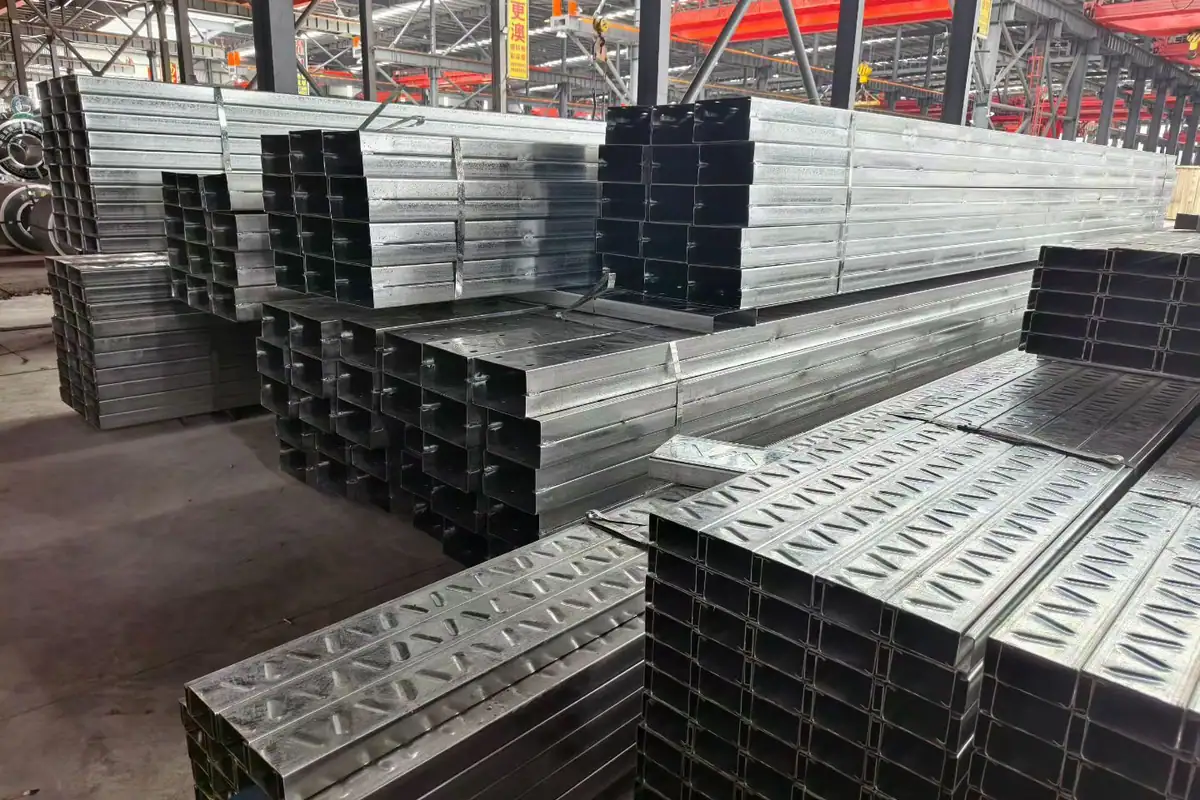
Key Points
- C- and Z-purlins are cold-formed secondary members that support roof or wall cladding and transfer loads to the primary frame.
- A section name alone is not a complete specification: thickness, grade, length, holes, coating and connections all need to be defined.
- Fabrication documents describe what to make; structural calculations decide whether the selected member is adequate for the actual loading.
- Define cutting, punching, surface treatment, inspection documents and delivery in the project documents before ordering, so quotations are comparable.
What the Fabrication Drawing Should Contain
A fabrication drawing for purlins should identify the section type, nominal dimensions, material thickness, steel grade, member length, hole pattern, splice arrangement and connection details. When corrosion protection or a project finish is required, the drawing should also state the surface treatment.
A C- or Z-section is not a complete purchasing description by itself. Two members with the same nominal depth can differ in thickness, flange dimensions, holes, coating and length. These differences affect weight, handling, connection work and how the member fits the roof or wall system.
Fabrication Variables vs Design Variables
Fabrication and structural design answer different questions. Fabrication documents define what is to be cut, punched, formed, marked and delivered. Structural calculations define whether the member is adequate for span, loading, restraint, deflection, web crippling, uplift and connection forces. Spacing, lap length, bracing and support conditions should therefore be confirmed against the project design, not selected from a general product table.
The distinction matters most for continuous Z-purlin systems. Overlapping members can redistribute moments across interior supports, but lap length, bolt layout and local limit states still need design verification. A simple-span C-purlin and a continuous Z-purlin may support similar cladding while behaving differently as structural systems.
Typical Fabrication Operations
Project-based purlin supply commonly includes:
- cutting members to the required length;
- punching or drilling holes shown on the approved drawing;
- roll-forming the strip or coil into the specified C or Z profile;
- preparing sleeves, cleats or other connection components when included in scope;
- applying galvanizing, painting or another specified surface treatment;
- marking members for erection and packing them by project or installation sequence.
The exact sequence depends on the equipment, material and project requirements. The useful procurement question is not whether a supplier has C or Z purlins, but whether the supplier can produce the required profile and hole pattern consistently from the approved drawings.
Inspection and Material Documentation
Inspection records should match the risks in the order. Typical checks include section dimensions, thickness, cut length, hole location, member identification and visible surface condition. Material certificates or mill documentation should identify the supplied material and connect it to the relevant batch or order records.
For special coating, tolerances or third-party inspection requirements, agree these items before production. They are easier to control when they are written into the drawing package, the purchase specification and the inspection plan.
Delivery and Site Coordination
Purlins are often delivered in bundles or project batches. Packing should protect members from deformation and make it possible to identify sections, lengths and installation zones after unloading. For overseas shipments, the delivery plan may also need to coordinate container loading, marking, documents and the order in which different roof or wall areas are installed.
These logistics decisions do not change the structural design. They support it by reducing identification errors, protecting the formed sections and keeping the erection sequence aligned with the approved drawings.
Pre-Order Checklist
| Item | Why it matters |
|---|---|
| C- or Z-section and nominal dimensions | Defines the profile and connection interface |
| Material grade and thickness | Affects strength, weight and coating performance |
| Cut length and quantity by member mark | Connects fabrication to the erection sequence |
| Hole pattern and connection accessories | Prevents rework and site drilling |
| Surface treatment | Galvanizing or painting per project requirement |
| Inspection records and material certificates | Documents compliance and traceability |
| Packing, marking and delivery sequence | Keeps site installation efficient |
| Design responsibility | Confirms who verifies span, spacing, laps, bracing and connections |
This checklist helps separate a comparable technical quotation from a price-only offer. It also gives the fabricator the information needed to review manufacturability before production begins.
FAQ
What should I send when requesting a purlin quotation?
Send the approved drawing or member list with section, grade, thickness, length, hole pattern, surface treatment, quantity and delivery destination. The more complete the package, the more comparable the quotation.
Can a C-purlin be used on a continuous span?
Yes, but it usually needs sleeves, stiffeners or splice plates, which add complexity and steel. For long continuous spans, Z-purlins are generally preferred because they can nest and lap at supports.
Do purlins still need structural design if the supplier provides a section table?
The supplier can confirm manufacturability and drawing feasibility, but section selection, spacing, lap length, bracing and connections should be verified by structural design for the actual loading, restraint and deflection requirements.
What documents should ship with the order?
Material certificates and dimensional inspection records are typical. Confirm the required documents and any third-party inspection before production.
Conclusion
Cold-formed purlins work as part of a roof or wall system, not as isolated catalogue items. The reliable workflow is to confirm the structural design first, define the fabrication details in approved drawings, agree the inspection documents, and then plan packing and delivery around the erection sequence.
Related Reading
For a side-by-side comparison of C and Z purlins on span, load and splicing, see C vs Z Purlins: How to Choose for Roof & Frame Systems. For project-based C/Z purlin supply, see the C & Z Purlins product page.